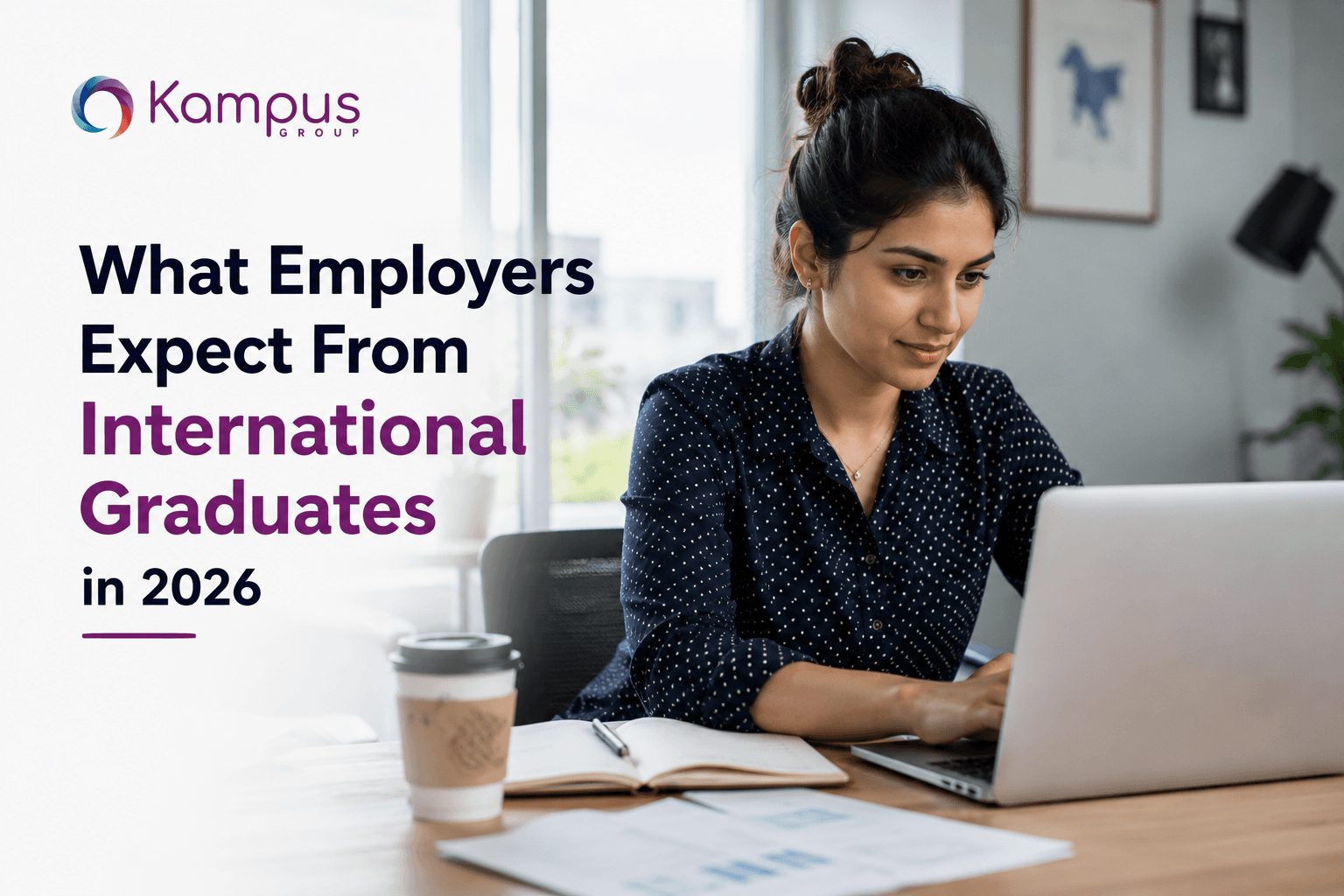
What Employers Expect From International Graduates in 2026
Studying abroad can give you an international degree, exposure to new cultures, and access to a wider professional network. But earning a degree is no longer enough to guarantee a smooth transition into the workplace.
In 2026, employers are increasingly looking beyond academic qualifications. They want graduates who can demonstrate practical skills, communicate effectively, solve problems, work with technology, and adapt to rapidly changing workplaces.
This is particularly important for international graduates. Competing for jobs in a new country often means demonstrating not only what you studied, but also how you can contribute to an organization from day one.
Recent employer research reflects this shift. The National Association of Colleges and Employers (NACE) reports that employers continue to prioritize communication, teamwork, professionalism, and critical thinking when assessing new graduates. At the same time, AI skills are becoming increasingly important, with more than one-third of entry-level jobs in its 2026 survey requiring AI skills. citeturn0search5turn0search6
So, what exactly are employers looking for from international graduates in 2026?
1. Strong Communication Skills
Being able to communicate clearly is one of the most important skills you can bring to an international workplace.
Employers want graduates who can explain ideas, write professional emails, participate in meetings, present information, and communicate with colleagues and clients.
This goes beyond simply speaking English fluently.
You need to understand how to communicate professionally.
For example, an employer may expect you to:
- Explain a complicated idea in simple language
- Write clear and professional reports
- Give presentations
- Participate confidently in meetings
- Ask useful questions
- Listen to feedback
- Communicate with people from different backgrounds
A 2026 GMAC survey of more than 600 global corporate recruiters found that communication, problem-solving, and adaptability remain among the most valued skills, while AI, technology, and data-analysis skills have increased substantially in importance. citeturn0search0
For international graduates, strong communication can also help overcome one of the biggest challenges of entering a new workplace: unfamiliar professional culture.
2. AI Literacy
You do not necessarily need to become an AI engineer.
But in 2026, employers increasingly expect graduates to understand how artificial intelligence can be used responsibly in their work.
AI literacy can mean knowing how to:
- Use AI tools to improve productivity
- Write effective prompts
- Check AI-generated information
- Identify errors and hallucinations
- Protect confidential information
- Use AI ethically
- Combine AI with human judgment
- Understand when not to use AI
NACE reported in July 2026 that more than one-third of entry-level jobs required AI skills, nearly triple the proportion reported only six months earlier. citeturn0search6
This means international students should not wait until graduation to start learning how AI applies to their industry.
A Marketing graduate, for example, could learn how to use AI for research, customer analysis, content ideation, and campaign optimization.
A Finance graduate could explore AI-assisted data analysis and financial modelling.
A Computer Science graduate will likely need a deeper understanding of AI development, data, automation, and software tools.
The important point is that AI literacy is becoming a workplace skill, not simply a technology skill.
3. Critical Thinking and Good Judgment
AI can produce an answer in seconds, but employers still need people who can determine whether that answer is actually useful.
That is why critical thinking is becoming increasingly valuable.
Employers want graduates who can:
- Evaluate information
- Identify unreliable sources
- Question assumptions
- Compare possible solutions
- Make decisions using evidence
- Recognize risks
- Explain why they reached a particular conclusion
QS reported in 2026 that employers continue to identify critical thinking and judgment as major graduate skill gaps, alongside problem-solving, communication, and adaptability. citeturn0search1
This is especially important in an AI-driven workplace.
Knowing how to generate information is useful. Knowing what to do with that information is much more valuable.
4. Problem-Solving Ability
Employers do not expect graduates to know everything.
They do expect them to know how to approach a problem.
Instead of simply saying, “I don’t know how to do this,” a strong graduate should be able to say:
“I don’t know yet, but here is how I would find out.”
That mindset is valuable because workplaces constantly present employees with unfamiliar situations.
You can demonstrate problem-solving through:
- University projects
- Internships
- Research
- Volunteering
- Student organizations
- Freelance work
- Personal projects
- Entrepreneurship
When preparing for interviews, don’t only talk about your responsibilities. Explain the problem you faced, what you did, and what changed as a result.
5. Adaptability
The workplace is changing quickly.
New technologies are emerging, companies are restructuring, industries are evolving, and some tasks that once required human workers are increasingly being automated.
Employers therefore want graduates who can learn and adapt.
A recent 2026 analysis from QS emphasizes adaptability as one of the key capabilities graduates need as AI and technological change reshape the workplace. citeturn0search4
For an international graduate, adaptability has an additional dimension.
You may already have experience adapting to:
- A new country
- A different education system
- A different culture
- New teaching methods
- Different communication styles
- New social and professional environments
Those experiences can become a strength when you know how to communicate them effectively.
6. Practical Work Experience
One of the biggest mistakes students make is assuming that their degree is their only qualification.
Employers increasingly want evidence that you can apply what you learned.
This is why internships, placements, part-time jobs, volunteering, research projects, freelance work, and industry projects can make such a difference.
In 2026, some employers are even redesigning internship programs to provide students with more substantial workplace experience as AI changes traditional entry-level tasks. EY, for example, introduced a year-long career residency model for some assurance interns, combining real projects, coaching, and skills development. citeturn0news23
As an international student, try to gain experience before graduation, rather than waiting until you start applying for full-time jobs.
Even a small project can help if you can clearly demonstrate what you contributed.
7. Teamwork
Modern workplaces rarely operate entirely through individual work.
Employers want people who can collaborate with colleagues, contribute to projects, handle disagreements professionally, and work toward shared goals.
NACE’s 2026 employer research identifies teamwork as one of the important career-readiness competencies expected from new graduates. citeturn0search5
International graduates can turn their multicultural experience into an advantage here.
If you have worked on university projects with people from different countries, participated in international student organizations, or collaborated with people with different perspectives, those experiences can demonstrate your ability to work across cultural differences.
8. Cultural Awareness
Being an international graduate can give you something that employers value: experience navigating different cultures.
However, simply being an international student is not enough.
You need to demonstrate that you understand how cultural differences can influence communication, teamwork, customer relationships, and workplace expectations.
For example, working successfully with an international team may require you to understand differences in:
- Communication styles
- Leadership expectations
- Meeting etiquette
- Feedback
- Time management
- Decision-making
- Workplace hierarchy
Cultural awareness can be particularly valuable in companies with international customers, distributed teams, or global operations.
9. Professionalism
Professionalism is often underestimated by students.
It includes the small behaviors that influence whether colleagues and employers trust you.
Employers may look at whether you:
- Arrive on time
- Meet deadlines
- Respond appropriately to messages
- Prepare for meetings
- Take responsibility for mistakes
- Accept feedback
- Follow through on commitments
- Treat colleagues respectfully
NACE’s 2026 research specifically identifies professionalism as an important career-readiness skill, while also noting that employers see room for improvement among new graduates. citeturn0search5
You don’t need years of work experience to demonstrate professionalism.
You can start developing it while you are still at university.
10. Data and Digital Skills
Almost every industry is becoming more data-driven.
You do not have to become a data scientist, but you should understand the digital tools relevant to your field.
Depending on your degree, this could include:
- Microsoft Excel
- Data visualization
- SQL
- CRM platforms
- Project management software
- Digital marketing tools
- Statistical software
- Industry-specific applications
- AI-powered productivity tools
The right tools depend on your career path.
A graduate applying for a marketing position will need a different digital toolkit from someone applying for an engineering or financial role.
The goal is not to collect as many certificates as possible. It is to develop useful, demonstrable skills.
11. A Strong Professional Online Presence
Employers increasingly encounter candidates online before or during recruitment.
Your LinkedIn profile, portfolio, personal website, GitHub account, professional social media presence, or other industry-specific platforms can help demonstrate what you can actually do.
Instead of simply writing:
“I am passionate about marketing.”
Show evidence.
You could include:
- A marketing campaign you developed
- A research project
- A design portfolio
- A data analysis project
- A software project
- A published article
- A research paper
- A business you helped build
Your goal should be to make it easy for an employer to answer one question:
“What can this person actually do?”
12. The Ability to Work Across Borders
International companies increasingly need employees who can operate across geographical and cultural boundaries.
International graduates can potentially bring experience with different markets, languages, cultures, and perspectives.
This can be especially valuable in areas such as:
- International business
- Consulting
- Technology
- Finance
- Marketing
- Development
- Tourism
- Education
- International relations
- Global supply chains
Your international background becomes an employability advantage when you can connect it to the employer’s actual business needs.
13. A Learning Mindset
One of the most important things employers can hire for is the ability to keep learning.
A degree gives you a foundation. It does not give you permanent protection from technological change.
In 2026, graduates are entering workplaces where the tools they use today may change significantly within a few years.
Employers therefore want people who can learn new systems, update their knowledge, and remain curious.
This is particularly important as AI automates routine tasks and shifts employees toward work requiring judgment, creativity, problem-solving, and strategic thinking. citeturn0news21turn0search0
What International Students Should Do Before Graduation
If you are currently studying abroad, don’t wait until your final semester to think about employability.
Start building evidence of your skills early.
Build a portfolio
Create something employers can see.
Depending on your field, this could be a website, design portfolio, research project, GitHub repository, business case, writing portfolio, or collection of academic and professional projects.
Get practical experience
Look for internships, placements, volunteering, research opportunities, campus jobs, freelance projects, and student organizations.
Your experience does not have to be perfect. It needs to demonstrate that you can apply your skills.
Learn AI tools relevant to your field
Don’t learn AI simply because it is trending.
Identify how AI is being used in your industry and learn the tools and workflows that are actually relevant.
Improve your communication
Practice presentations, interviews, professional writing, networking, and workplace conversations.
Build relationships before you need a job
Connect with professors, alumni, employers, career advisers, professional associations, and people working in your target industry.
Networking is much easier when you are building genuine professional relationships rather than asking everyone for a job.
Learn how recruitment works in your destination country
Hiring practices differ between countries.
Understand how employers in your target market approach:
- CVs and resumes
- Cover letters
- Interviews
- Networking
- References
- Graduate schemes
- Internships
- Work authorization
This can prevent avoidable mistakes during your job search.
The international graduate job market in 2026 is becoming increasingly skills-focused.
Your degree still matters, but employers want to see what you can do with it.
The strongest candidates are likely to be those who combine technical knowledge with communication, critical thinking, problem-solving, adaptability, AI literacy, teamwork, and practical experience.
For international graduates, there is another important advantage: your experience of studying and living abroad can demonstrate independence, resilience, cultural awareness, and adaptability.
But you need to make those qualities visible.
Don’t simply tell employers that you are an international graduate.
Show them what your international experience has taught you, what skills you have developed, and how those skills can help their organization.
Frequently Asked Questions
Do employers value international graduates in 2026?
Yes. International graduates can offer valuable skills such as cultural awareness, adaptability, language abilities, and experience working across different environments. However, employers still expect evidence of relevant professional and technical skills.
Is a degree enough to get a job after studying abroad?
Not necessarily. A degree provides academic knowledge, but employers increasingly look for practical experience, communication, problem-solving, digital skills, and evidence that you can apply what you learned.
What soft skills do employers want from graduates?
Communication, teamwork, critical thinking, problem-solving, adaptability, and professionalism are among the most important skills employers look for in new graduates.
What soft skills do employers want from graduates?
Communication, teamwork, critical thinking, problem-solving, adaptability, and professionalism are among the most important skills employers look for in new graduates.
How can international students gain work experience?
Students can look for internships, part-time jobs, volunteering, research projects, university placements, freelance work, student organizations, and industry-related projects.
Does cultural awareness help international graduates get jobs?
It can. Cultural awareness can be particularly useful for companies working with international customers, multicultural teams, and global markets. The key is to demonstrate how your experience translates into workplace value.
What should international students put on their CV?
Focus on relevant education, practical experience, projects, measurable achievements, technical skills, AI or digital skills, leadership, volunteering, and other evidence that demonstrates your ability to contribute to the role.
What is the biggest mistake international graduates make?
One common mistake is relying too heavily on their degree while failing to demonstrate practical experience and transferable skills. In a competitive graduate market, employers need evidence of what you can contribute—not just what you studied.

Written by
Fimijoba Micheal Oladokun is an International Student Consultant, SEO Specialist and Technical Writer at Kampus Group Nigeria. He leverages data-driven insights to support strategic decision-making while guiding prospective international students through admissions and study abroad processes. He also creates clear, SEO-optimized technical content that enhances digital engagement and simplifies complex educational topics.
Get a free, unbiased assessment from a Kampus Group advisor — no obligation, completely free.
More on Career Outcomes
How University Incubators Help Student Entrepreneurs Succeed
Starting a business while studying at university can feel overwhelming. You may have a great idea, but turning that idea into a sustainable business requires more than enthusiasm. You need guidance, access to resources,
21 Aug 2026
How International Students Can Prepare for AI-Driven Recruitment
Artificial intelligence is changing the way companies recruit employees. From screening applications to scheduling interviews and assessing candidates, employers are increasingly using technology to manage large numbers
14 Aug 2026
How to Build an International Resume While Still in University
Your university years are about more than earning a degree. They are also an opportunity to build the experience, skills, and professional profile you’ll need when you start applying for internships and jobs. For interna
14 Aug 2026