Countries Leading in Robotics Education for International Students
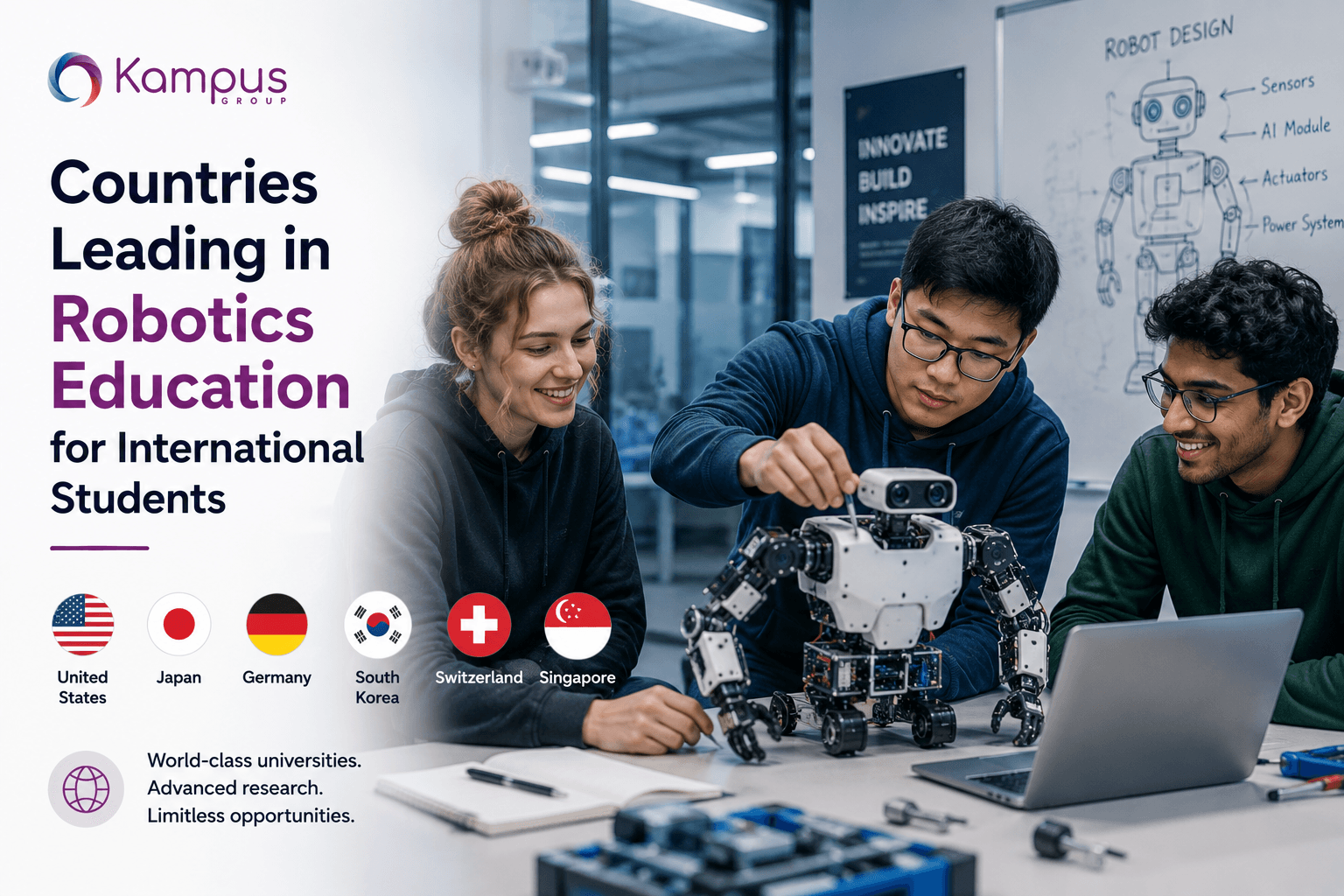
Robotics is no longer a futuristic concept confined to research laboratories. Robots are already being used in manufacturing, healthcare, logistics, agriculture, transportation, space exploration, and many other industries.
As artificial intelligence, automation, computer vision, and autonomous systems continue to develop, the demand for people who can design, build, program, and manage robotic systems is also growing.
For international students, this makes robotics an increasingly attractive field of study.
However, choosing where to study robotics requires more than looking at university rankings. The best destinations combine strong engineering education with research facilities, robotics companies, innovation ecosystems, practical training, and opportunities to work on real-world applications.
Current 2026 research and university data highlight countries including the United States, Japan, Germany, South Korea, Switzerland, Sweden, the United Kingdom, Singapore, and Denmark as important destinations for robotics education and research. citeturn0search0turn0search6
So, which countries should international students consider?
1. United States
The United States is one of the world’s strongest destinations for robotics education and research.
Its universities have played an important role in the development of robotics, artificial intelligence, autonomous systems, computer vision, and human-robot interaction.
Universities such as Carnegie Mellon University, Massachusetts Institute of Technology (MIT), Stanford University, University of Michigan, and University of Pennsylvania are associated with major robotics research programs and laboratories.
The country’s advantage goes beyond universities.
The US has a large technology and startup ecosystem, providing opportunities for students interested in turning robotics research into commercial products.
Why study Robotics in the USA?
- World-class robotics research
- Strong artificial intelligence ecosystem
- Advanced robotics laboratories
- Major technology and engineering companies
- Strong startup ecosystem
- Opportunities across healthcare, manufacturing, autonomous systems, and space technology
The major drawback is cost. Tuition and living expenses can be substantially higher than in many European destinations, so international students should investigate scholarships, assistantships, and funding opportunities early.
The US is particularly attractive for students who want to pursue robotics research, AI, autonomous systems, or entrepreneurship.
2. Japan
Japan has one of the strongest relationships between robotics education and real-world industrial applications.
Robotics is deeply connected to Japan’s manufacturing, electronics, automotive, healthcare, and automation industries.
This creates an environment where students can see how robotic technologies move from research laboratories into practical applications.
Japanese universities also offer research opportunities in areas such as humanoid robotics, industrial automation, mechanical engineering, computer vision, and intelligent systems.
Japan remained one of the world’s major industrial robotics markets, making its industrial ecosystem particularly relevant for students interested in automation. citeturn0search2
Why study Robotics in Japan?
- Strong robotics industry
- Advanced manufacturing
- Industrial automation
- Robotics research laboratories
- Strong engineering education
- Opportunities in humanoid and service robotics
- Close relationship between robotics and manufacturing
Japan is particularly suitable for students interested in industrial robotics, mechanical engineering, automation, and human-robot interaction.
International students should also consider language and cultural factors. Some graduate programs are available in English, but Japanese can be extremely useful for internships, employment, and everyday life.
3. Germany
Germany is one of Europe’s leading countries for robotics and automation.
Its strength comes from the combination of engineering education, manufacturing, industrial automation, and research.
The country’s automotive and industrial sectors create significant demand for technologies involving robotics, automation, autonomous systems, and intelligent manufacturing.
Germany recorded nearly 27,000 industrial robot installations in 2024 and had one of the world’s highest robot densities in manufacturing, according to data cited by current robotics education research. citeturn0search2
German universities also offer specialized programs in robotics and related fields.
Why study Robotics in Germany?
- Strong engineering tradition
- Advanced manufacturing industry
- Industrial robotics
- Automation research
- Strong university-industry connections
- Numerous engineering universities
- Opportunities in automotive and manufacturing
Universities such as Technical University of Munich (TUM) and RWTH Aachen University are particularly relevant for students interested in robotics and automation.
Germany can also be attractive to international students who are looking for European study options, although tuition and semester fees vary by university, state, and student status.
4. South Korea
South Korea has developed into a major technology and manufacturing economy, making it an increasingly interesting destination for robotics students.
The country is home to major technology, electronics, automotive, and manufacturing companies, creating a strong environment for automation and robotics.
Students can explore areas such as:
- Industrial robotics
- Artificial intelligence
- Autonomous systems
- Computer vision
- Smart manufacturing
- Human-robot interaction
- Service robotics
Why study Robotics in South Korea?
- Advanced technology sector
- Strong manufacturing industry
- Robotics and automation research
- Artificial intelligence expertise
- Smart-factory development
- Strong electronics industry
South Korea is particularly interesting for students who want to combine robotics with AI, electronics, automation, and advanced manufacturing.
5. Switzerland
Switzerland may be smaller than many countries on this list, but it has a significant reputation for advanced robotics research.
Institutions such as ETH Zurich and EPFL are internationally recognized for engineering, computer science, robotics, and autonomous systems research.
Switzerland also has an advanced technology and engineering ecosystem.
Why study Robotics in Switzerland?
- High-quality engineering education
- Strong robotics research
- Advanced laboratories
- Autonomous systems research
- Strong engineering industry
- Excellent research environment
Students interested in advanced robotics research may find Switzerland particularly appealing.
However, the cost of living can be high, so financial planning is important.
6. Sweden
Sweden is another strong European destination for robotics and automation.
The country has a strong reputation for engineering, innovation, industrial technology, and research.
Universities such as KTH Royal Institute of Technology and Lund University offer opportunities related to robotics, automation, artificial intelligence, and intelligent systems. citeturn0search2
Sweden’s industrial ecosystem also includes companies involved in automation and advanced engineering.
Why study Robotics in Sweden?
- Strong engineering education
- Robotics and automation research
- Innovation-focused economy
- Strong industrial technology sector
- AI and autonomous-systems research
- English-taught postgraduate opportunities
Sweden can be a good option for students who want a combination of robotics, AI, sustainability, and industrial innovation.
7. United Kingdom
The United Kingdom has a strong research ecosystem in robotics, artificial intelligence, computer science, and engineering.
Universities including University of Oxford, Imperial College London, University of Edinburgh, and University of Manchester have research strengths in robotics and related technologies.
European robotics education comparisons also highlight several UK institutions among leading options for international students. citeturn0search10
Why study Robotics in the UK?
- Strong research universities
- Advanced AI research
- Robotics and autonomous systems
- Strong computer science programs
- Large technology ecosystem
- Many English-taught programs
The UK is particularly attractive for students who want to combine robotics with AI, computer science, autonomous systems, or research.
The main consideration is cost, particularly for international students at highly ranked universities.
8. Singapore
Singapore offers a different kind of robotics ecosystem.
Rather than having a huge manufacturing base like Germany or Japan, Singapore has developed a technology-focused environment built around automation, artificial intelligence, smart infrastructure, logistics, healthcare, and advanced manufacturing.
Its compact urban environment also makes it an interesting location for testing technologies involving autonomous systems and smart infrastructure.
Why study Robotics in Singapore?
- Strong technology ecosystem
- Advanced manufacturing
- Artificial intelligence research
- Smart-city applications
- Strong university-industry connections
- Strategic location in Asia
Singapore can be particularly attractive to students interested in robotics + AI + smart cities + automation.
9. Denmark
Denmark is an increasingly important European hub for robotics and automation.
The country’s robotics ecosystem includes a significant concentration of companies, particularly around the Odense robotics cluster.
Universities such as the University of Southern Denmark and Aalborg University offer robotics-related programs.
Why study Robotics in Denmark?
- Strong robotics industry
- Automation expertise
- Research and industry collaboration
- Practical learning opportunities
- Strong engineering education
- English-taught master’s programs
Denmark can be an excellent choice for students who want to connect academic learning with industrial robotics and automation.
10. Canada
Canada is another destination worth considering, particularly for students interested in robotics, artificial intelligence, computer vision, and autonomous systems.
The country’s strong AI research ecosystem complements robotics education, particularly in areas involving machine learning, perception, and intelligent systems.
Canadian universities also provide opportunities for interdisciplinary research connecting engineering, computer science, AI, and robotics.
Why study Robotics in Canada?
- Strong AI research
- Robotics and autonomous systems
- Computer vision
- Engineering education
- Research-intensive universities
- Technology and startup opportunities
Canada may be particularly suitable for students who want to study robotics alongside artificial intelligence and machine learning.
Which Country Is Best for Robotics?
There is no universal winner.
The best destination depends on the type of robotics you want to study.
Best for Robotics Research
USA, Switzerland, UK, Germany
These countries have strong research universities and advanced laboratories.
Best for Industrial Robotics
Japan, Germany, South Korea, Denmark
These countries have strong manufacturing and automation ecosystems.
Best for Robotics and AI
USA, UK, Canada, Singapore, South Korea
These destinations offer strong connections between robotics, artificial intelligence, computer science, and autonomous systems.
Best for Engineering-Focused Robotics
Germany, Japan, Switzerland, Sweden
These countries are particularly strong in mechanical engineering, automation, control systems, and advanced manufacturing.
Best for Robotics Startups
USA, Singapore, UK, Germany
Students interested in entrepreneurship can benefit from large technology ecosystems and startup communities.
What Do You Study in a Robotics Degree?
Robotics is an interdisciplinary field.
A robotics program may combine:
- Mechanical engineering
- Electrical engineering
- Computer science
- Artificial intelligence
- Mathematics
- Control systems
- Computer vision
- Machine learning
- Electronics
- Mechatronics
- Autonomous systems
- Robotics programming
This interdisciplinary nature is one of the reasons robotics graduates can work across multiple industries.
You may build a robot mechanically, program its behavior, train its perception system, and design the control algorithms that allow it to move.
What Skills Should International Robotics Students Develop?
Getting a robotics degree is only one part of becoming competitive.
Students should also develop practical technical skills.
Programming
Languages such as Python and C++ are widely useful in robotics and AI.
Mathematics
Linear algebra, calculus, probability, statistics, and differential equations can become important depending on your specialization.
Electronics
Understanding sensors, circuits, microcontrollers, and embedded systems can help you build physical robotic systems.
Mechanical Design
Knowledge of CAD, mechanics, kinematics, and dynamics is useful for students interested in designing robots.
Artificial Intelligence
Machine learning and computer vision are increasingly important in robotics.
Control Systems
Control theory helps robots interact with the physical world accurately and safely.
Communication and Teamwork
Robotics projects are rarely completed by one person.
Students may work alongside mechanical engineers, electrical engineers, software developers, AI researchers, designers, and business professionals.
What Should International Students Look for in a Robotics University?
Don’t choose a university simply because it appears on a “top robotics universities” list.
Look at the actual program.
Check the curriculum
Does it focus on the area you want?
A robotics program emphasizing industrial automation may be very different from one focused on humanoid robots or autonomous vehicles.
Look at the laboratories
Find out whether students have access to robotics labs, autonomous platforms, simulation environments, sensors, manufacturing equipment, or other relevant facilities.
Investigate research opportunities
If you plan to pursue a master’s or PhD, research opportunities can be especially important.
Look at industry partnerships
A university with strong connections to robotics companies can provide opportunities for internships, projects, and employment.
Check language requirements
Some programs are taught entirely in English, while others require local-language proficiency.
Consider the total cost
Don’t look only at tuition.
Consider:
- Accommodation
- Food
- Transportation
- Health insurance
- Student fees
- Equipment
- Visa costs
- Travel
- Other living expenses
Robotics Career Opportunities
A robotics degree can lead to careers in many industries.
Graduates can work as:
- Robotics engineers
- Automation engineers
- Robotics software engineers
- AI engineers
- Control systems engineers
- Computer vision engineers
- Mechatronics engineers
- Autonomous systems engineers
- Research scientists
- Embedded systems engineers
- Machine learning engineers
- Robotics technicians
- Product engineers
Robotics is also increasingly connected to sectors such as healthcare, logistics, agriculture, aerospace, automotive manufacturing, and energy.
This means your career options do not necessarily require you to work for a company that calls itself a “robotics company.”
Frequently Asked Questions
Which country is best for studying Robotics?
The USA, Japan, Germany, South Korea, Switzerland, Sweden, the UK, Singapore, Denmark, and Canada are all strong options. The best choice depends on whether you are more interested in AI, industrial automation, research, mechanical engineering, autonomous systems, or another specialization.
Is Japan still a good country for Robotics in 2026?
Yes. Japan remains a major robotics and automation market and has strong connections between robotics research, manufacturing, and industry.
Is Germany good for international Robotics students?
Yes. Germany combines strong engineering universities with a major industrial and automation ecosystem. It can be particularly attractive for students interested in industrial robotics and manufacturing.
Is Robotics a good degree for international students?
Robotics can be a strong choice for students with interests in engineering, computer science, artificial intelligence, automation, and technology. However, students should research the specific career and work opportunities available after graduation in their chosen country.
Do I need to study Computer Science to become a robotics engineer?
No. Robotics is interdisciplinary. Students can enter the field through mechanical engineering, electrical engineering, mechatronics, computer science, AI, or dedicated robotics programs.
Is Robotics difficult to study?
Robotics can be academically demanding because it combines mathematics, programming, engineering, electronics, and physics. Students who enjoy solving technical problems and working across disciplines are generally well suited to the field.
Can international students work in Robotics after graduation?
Potentially, yes, but work authorization depends on the immigration rules of the country where you study. Students should research post-study work options and employer sponsorship requirements before choosing a destination.

Written by
Fimijoba Micheal Oladokun is an International Student Consultant, SEO Specialist and Technical Writer at Kampus Group Nigeria. He leverages data-driven insights to support strategic decision-making while guiding prospective international students through admissions and study abroad processes. He also creates clear, SEO-optimized technical content that enhances digital engagement and simplifies complex educational topics.
Get a free, unbiased assessment from a Kampus Group advisor — no obligation, completely free.
More on Destinations

Countries With Low Student Health Insurance Costs
When planning to study abroad, most students think about tuition, living costs, and visa fees — but one of the biggest overlooked expenses is health insurance. In many countries, international students are required to ha
4 Jan 2026
Affordable Study Destinations With High-Quality Education
Studying abroad is a dream for many students across Africa especially for those seeking global exposure, top-tier education, and better career opportunities. However, one major concern for most international students is
10 Oct 2025
How to Switch from a Student Visa to a Work Visa Abroad
Studying abroad is a dream for many students, but for most, the ultimate goal is to build a successful career overseas. The good news is that many countries allow international students to transition from a student visa
3 Sept 2025