Best Countries to Study Renewable Materials and Sustainable Manufacturing
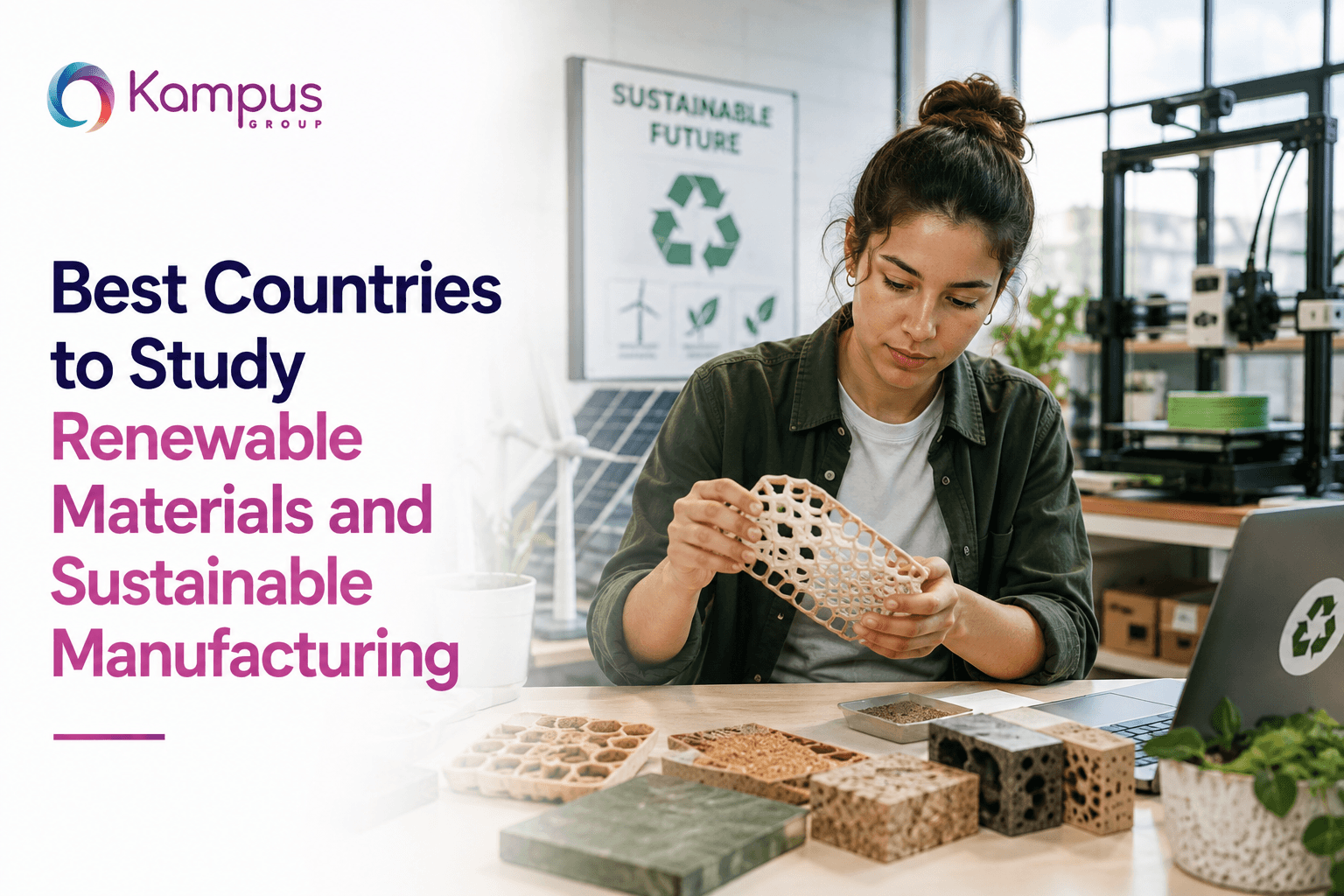
The materials used to build products are changing.
Manufacturers are increasingly looking beyond conventional fossil-fuel-based materials and energy-intensive production methods. Researchers and companies are developing biodegradable polymers, bio-based composites, recycled materials, low-carbon metals, sustainable packaging, circular production systems, and new manufacturing processes designed to reduce waste and emissions.
At the same time, manufacturing itself is becoming smarter.
Automation, artificial intelligence, digital twins, additive manufacturing, robotics, renewable energy, and advanced recycling are changing how products are designed and produced.
This has created a growing academic field at the intersection of materials science, engineering, chemistry, manufacturing, environmental science, and sustainability.
For international students, studying in a country with a strong research and manufacturing ecosystem can provide access to advanced laboratories, industry partnerships, research projects, and emerging green technologies.
The United States, Germany, Sweden, Netherlands, Japan, Denmark, Finland, Switzerland, Singapore, and Canada are particularly strong destinations to consider. The 2026 QS Materials Sciences rankings place MIT first globally, followed by the National University of Singapore, while universities in Switzerland, the Netherlands, Sweden, Germany, Japan, Canada, and other countries also appear among the leading institutions.
So, which countries offer the best opportunities?
1. Germany
Germany is one of the strongest destinations for students interested in sustainable manufacturing.
The country has a powerful industrial base covering automotive manufacturing, machinery, chemicals, engineering, renewable energy, and advanced materials.
This makes Germany particularly interesting for students who want to understand how sustainability can be applied at an industrial scale.
German research institutions and universities work on areas such as:
- Sustainable materials
- Recycling
- Circular manufacturing
- Lightweight materials
- Industrial biotechnology
- Additive manufacturing
- Energy-efficient production
- Sustainable automotive technologies
Germany is also home to a large applied-research ecosystem, allowing students to see how laboratory research can be translated into industrial applications.
Why study Sustainable Manufacturing in Germany?
- Strong manufacturing industry
- Advanced engineering
- Industrial research
- Circular-economy development
- Automotive innovation
- Materials science
- Renewable-energy integration
- Strong university-industry relationships
Germany is particularly suitable for students interested in engineering, manufacturing, materials science, automotive technology, and industrial sustainability.
2. Sweden
Sweden is one of Europe’s strongest destinations for sustainability-focused education and research.
The country’s universities and companies have invested heavily in areas such as circular economies, sustainable materials, renewable energy, responsible manufacturing, and climate technology.
The 2026 QS World University Rankings: Sustainability placed Lund University first globally, while Swedish institutions including Uppsala University, the University of Gothenburg, and KTH Royal Institute of Technology also performed strongly.
Sweden’s materials-science ecosystem is also strong. KTH ranked among the world’s leading universities for Materials Sciences in 2026.
Why study in Sweden?
- Strong sustainability research
- Circular economy
- Renewable materials
- Green manufacturing
- Advanced materials science
- Environmental engineering
- Strong innovation ecosystem
- International academic environment
Sweden is particularly attractive if you want to combine materials science with sustainability, environmental engineering, or industrial innovation.
3. Netherlands
The Netherlands has developed a strong reputation for sustainable technology, circular economy research, advanced engineering, and resource-efficient production.
Its universities are particularly strong in materials science and engineering. Delft University of Technology ranked 14th globally in the 2026 QS Materials Sciences ranking.
The country also provides an interesting environment for studying circular systems because sustainability is closely connected to its engineering, infrastructure, agriculture, water management, and logistics sectors.
Why study in the Netherlands?
- Circular economy
- Materials science
- Sustainable engineering
- Advanced manufacturing
- Water and environmental technology
- Strong research universities
- International academic environment
- Many English-taught programs
The Netherlands is especially appealing to students interested in circular manufacturing, sustainable materials, industrial design, and environmental technology.
4. United States
The United States offers one of the world’s largest research ecosystems for materials science and advanced manufacturing.
MIT ranked first globally for Materials Sciences in the 2026 QS subject rankings, with Stanford, Harvard, UC Berkeley, and several other US universities also appearing among the world’s leading institutions.
Students can explore areas such as:
- Advanced polymers
- Nanomaterials
- Biomaterials
- Renewable materials
- Energy materials
- Additive manufacturing
- Battery materials
- Sustainable chemistry
- Recycling technologies
The US also has a large technology and startup ecosystem, which can be valuable for students interested in commercializing sustainable materials or manufacturing technologies.
Why study in the USA?
- World-class materials research
- Advanced manufacturing
- Biotechnology
- Nanotechnology
- Strong startup ecosystem
- Extensive research funding
- Large industrial base
The major disadvantage is cost. International tuition and living expenses can be significantly higher than in some European destinations.
5. Japan
Japan is an excellent destination for students interested in advanced materials and efficient manufacturing.
The country’s manufacturing expertise spans automotive technology, electronics, robotics, precision engineering, chemicals, and advanced materials.
The University of Tokyo ranked among the world’s top institutions for Materials Sciences in 2026, while Institute of Science Tokyo also ranked highly.
Japan’s manufacturing culture also places considerable emphasis on efficiency, quality, resource use, and waste reduction.
Why study in Japan?
- Advanced materials research
- Precision manufacturing
- Robotics and automation
- Electronics
- Automotive technology
- Materials engineering
- Manufacturing efficiency
Japan is particularly suitable for students who want to combine materials science with robotics, automation, electronics, or advanced manufacturing.
6. Denmark
Denmark is a strong destination for students interested in sustainability, renewable energy, circular systems, and green manufacturing.
Its innovation ecosystem is closely connected to areas such as wind energy, sustainable infrastructure, energy efficiency, biotechnology, and environmentally responsible production.
European sustainability research also highlights Denmark as an important destination for studying areas such as renewable energy and green transition technologies.
Why study in Denmark?
- Renewable-energy expertise
- Sustainable manufacturing
- Circular economy
- Green technology
- Energy-efficient production
- Strong research-industry connections
- Sustainability-focused innovation
Denmark is particularly attractive for students interested in renewable energy, sustainable production systems, green materials, and circular economy.
7. Finland
Finland has developed a strong research ecosystem around sustainable materials, forestry, bioeconomy, circular economy, and clean technology.
The country’s large forest resources have also encouraged research into wood-based materials and bio-based alternatives to petroleum-derived products.
Students can explore:
- Bio-based materials
- Wood technology
- Sustainable packaging
- Circular economy
- Recycling
- Clean manufacturing
- Renewable resources
- Sustainable product design
Finland is also recognized as a strong European environment for sustainability research and circular-economy education.
Why study in Finland?
- Bioeconomy
- Sustainable materials
- Forest-based innovation
- Circular economy
- Clean technology
- Strong research culture
- Advanced engineering
Finland is especially interesting for students who want to explore renewable materials derived from biological resources.
8. Switzerland
Switzerland offers a highly research-intensive environment for materials science and sustainable engineering.
ETH Zurich and EPFL are among the world’s strongest institutions for Materials Sciences. ETH Zurich ranked joint 10th globally and EPFL 13th in the 2026 QS Materials Sciences ranking.
Swiss research is particularly strong in advanced engineering, chemistry, materials, precision manufacturing, biotechnology, and energy technologies.
Why study in Switzerland?
- Advanced materials research
- Engineering excellence
- Sustainable technology
- Nanotechnology
- Biotechnology
- Precision manufacturing
- Strong research infrastructure
Switzerland is particularly suitable for students interested in research-intensive materials science and advanced sustainable technologies.
The main challenge is the high cost of living.
9. Singapore
Singapore has emerged as an important hub for materials science, advanced manufacturing, biotechnology, and technology research in Asia.
The National University of Singapore (NUS) ranked second globally for Materials Sciences in the 2026 QS subject rankings, while Nanyang Technological University ranked joint third.
Singapore’s combination of advanced manufacturing, electronics, biotechnology, and research infrastructure creates opportunities to study materials from both scientific and industrial perspectives.
Why study in Singapore?
- World-class materials research
- Advanced manufacturing
- Semiconductor ecosystem
- Biotechnology
- Nanotechnology
- Strong university-industry collaboration
- Strategic position in Asia
Singapore is particularly attractive for students interested in advanced materials, electronics, manufacturing, biotechnology, and sustainable technology.
10. Canada
Canada is another strong destination for students interested in sustainable materials and manufacturing.
The country has major strengths in engineering, mining, forestry, clean technology, advanced manufacturing, and environmental research.
Its natural-resource industries also create opportunities to study how materials can be extracted, processed, recycled, and reused more sustainably.
The University of Toronto ranked among the leading global universities for Materials Sciences in 2026.
Why study in Canada?
- Strong materials research
- Clean technology
- Advanced manufacturing
- Forestry and bio-based materials
- Recycling
- Mining and materials engineering
- Environmental research
Canada is particularly suitable for students interested in materials engineering, sustainable resource management, recycling, and clean manufacturing.
What Are Renewable Materials?
Renewable materials are materials made from resources that can be naturally replenished.
Examples include:
- Wood
- Bamboo
- Natural fibers
- Plant-based polymers
- Cellulose
- Agricultural residues
- Bio-based composites
- Algae-derived materials
Researchers are developing these materials as alternatives to materials that depend heavily on fossil fuels or non-renewable resources.
However, “renewable” does not automatically mean “sustainable.”
A material’s environmental impact can also depend on how it is produced, transported, processed, used, and disposed of.
That is why students in this field need to understand the entire life cycle of a material.
What Is Sustainable Manufacturing?
Sustainable manufacturing involves producing goods while reducing environmental impact and using resources more efficiently.
It can involve:
- Lower energy consumption
- Reduced material waste
- Renewable energy
- Recycling
- Reuse
- Cleaner production
- Efficient water use
- Low-carbon processes
- Circular product design
- Sustainable supply chains
The goal is not simply to manufacture “green” products.
It is to rethink the entire production system.
Renewable Materials vs. Recycled Materials
These concepts are related but different.
Renewable materials come from resources that can be replenished, such as plants or sustainably managed forests.
Recycled materials are recovered from existing products or waste and processed for reuse.
For example, a bioplastic made from plant-based feedstocks may be renewable, while recycled aluminum is not renewable but can significantly reduce the need for new raw materials.
Modern sustainable manufacturing often combines both approaches.
What Do Students Study?
A degree in this area may involve several disciplines.
Depending on the program, you may study:
- Materials science
- Chemistry
- Chemical engineering
- Mechanical engineering
- Environmental engineering
- Manufacturing engineering
- Polymer science
- Nanotechnology
- Biotechnology
- Industrial design
- Life-cycle assessment
- Circular economy
- Sustainable product development
- Renewable energy
- Data analysis
This interdisciplinary nature makes the field suitable for students who enjoy both science and practical problem-solving.
Popular Specializations
Bio-Based Materials
Study materials derived from biological resources such as plants, agricultural waste, algae, or forestry products.
Sustainable Polymers
Develop alternatives to conventional petroleum-based plastics.
Circular Manufacturing
Design manufacturing systems around reuse, repair, remanufacturing, and recycling.
Green Chemistry
Develop chemical processes and materials that reduce toxicity, waste, and environmental impact.
Advanced Manufacturing
Use technologies such as additive manufacturing, automation, robotics, and digital manufacturing to reduce material and energy consumption.
Sustainable Packaging
Develop packaging that uses fewer resources and can be reused, recycled, or safely biodegraded.
Life-Cycle Assessment
Evaluate the environmental impact of a product or material from raw-material extraction through production, use, and disposal.
What Skills Should International Students Develop?
A strong academic foundation is important, but students should also develop practical skills.
Materials Characterization
Learn how researchers analyze the physical, chemical, thermal, and mechanical properties of materials.
Data Analysis
Modern materials research generates large quantities of experimental data.
Knowledge of statistics and programming can therefore be useful.
CAD and Digital Manufacturing
Computer-aided design and digital manufacturing skills can be valuable for students interested in sustainable product development.
Life-Cycle Assessment
Understanding environmental impacts across a product’s entire life cycle is increasingly important.
Programming
Python and other programming languages can support simulation, data analysis, optimization, and materials informatics.
Systems Thinking
Sustainable manufacturing requires understanding how materials, energy, transportation, production, consumption, and waste interact.
Career Opportunities
A degree in renewable materials or sustainable manufacturing can lead to careers across several industries.
Graduates may work as:
- Materials engineer
- Sustainable manufacturing engineer
- Materials scientist
- Polymer scientist
- Process engineer
- Environmental engineer
- Sustainability consultant
- Circular-economy specialist
- Product development engineer
- Manufacturing engineer
- Materials researcher
- Life-cycle assessment analyst
- Sustainable product designer
- Clean-technology specialist
Potential employers include:
- Manufacturing companies
- Automotive companies
- Renewable-energy companies
- Chemical companies
- Packaging companies
- Biotechnology firms
- Research institutions
- Engineering consultancies
- Consumer-goods companies
- Clean-technology startups
Which Country Is Best for Renewable Materials?
The answer depends on the material you want to study.
Best for Bio-Based Materials
Finland, Sweden, Netherlands, Canada
These countries have strong research ecosystems involving forestry, biomass, bioeconomy, and sustainable materials.
Best for Advanced Materials
USA, Switzerland, Singapore, Japan, Germany
These countries have highly developed materials-science and engineering research.
Best for Sustainable Manufacturing
Germany, Sweden, Denmark, Netherlands, Japan
These countries combine strong manufacturing industries with sustainability and efficiency research.
Best for Circular Economy
Netherlands, Sweden, Finland, Denmark, Germany
These destinations are particularly relevant to students interested in waste reduction, recycling, reuse, and resource efficiency.
How to Choose the Right University
Don’t choose a university simply because it offers a degree with “Sustainability” in the title.
Look closely at the curriculum.
Ask:
- Does the program include materials science?
- Are there dedicated sustainability laboratories?
- Does the university collaborate with manufacturers?
- Are there research projects for students?
- Can students participate in internships?
- Does the university have recycling or circular-economy research?
- Are there opportunities to work with renewable materials?
- What industries recruit graduates?
- Is the program taught in English?
- What are the total tuition and living costs?
The right program should match your intended specialization.
Frequently Asked Questions
Which country is best for studying Renewable Materials?
Finland, Sweden, the Netherlands, Canada, Germany, Switzerland, and the USA are strong options. The best choice depends on whether you are interested in bio-based materials, polymers, composites, recycling, or advanced materials.
Which country is best for Sustainable Manufacturing?
Germany, Sweden, Denmark, Japan, and the Netherlands are particularly strong choices because of their manufacturing industries, engineering capabilities, and sustainability-focused innovation ecosystems.
What are renewable materials?
Renewable materials are materials produced from resources that can be naturally replenished, such as wood, plant fibers, cellulose, agricultural residues, and certain bio-based polymers.
Are renewable materials the same as sustainable materials?
No. A renewable material comes from a replenishable resource, but sustainability depends on the entire life cycle of the material, including how it is sourced, manufactured, transported, used, and disposed of.
Is Sustainable Manufacturing a good career?
Yes. As manufacturers work to reduce emissions, waste, energy consumption, and material use, there is growing demand for engineers and specialists who understand sustainable production systems.
Can renewable materials replace plastic?
Some bio-based materials can replace certain conventional plastic applications, but there is no single material that can replace all plastics. Performance, cost, durability, recyclability, and environmental impact all need to be considered.
What is circular manufacturing?
Circular manufacturing is an approach that keeps materials and products in use for as long as possible through strategies such as reuse, repair, remanufacturing, refurbishment, and recycling.

Written by
Fimijoba Micheal Oladokun is an International Student Consultant, SEO Specialist and Technical Writer at Kampus Group Nigeria. He leverages data-driven insights to support strategic decision-making while guiding prospective international students through admissions and study abroad processes. He also creates clear, SEO-optimized technical content that enhances digital engagement and simplifies complex educational topics.
Get a free, unbiased assessment from a Kampus Group advisor — no obligation, completely free.
More on Destinations

Countries Investing the Most in Innovation and Research
Innovation has become one of the biggest drivers of economic growth, global competitiveness, and technological leadership. Countries that invest heavily in research and development (R&D) are often the same ones producing
28 Aug 2026
Best Countries to Study Agricultural Technology and Agribusiness
Agriculture is changing rapidly. Farming is no longer only about land, crops, livestock, and traditional production methods. Artificial intelligence, robotics, drones, sensors, satellite imagery, precision agriculture, b
28 Aug 2026
Countries With the Best Research Opportunities for Undergraduate Students
Research is no longer something students have to wait until postgraduate school to experience. Today, undergraduate students can participate in research projects, work alongside professors, join university laboratories,
28 Aug 2026